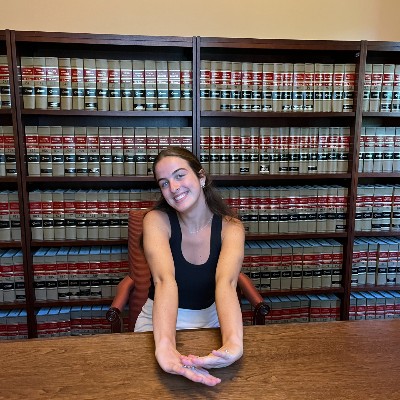
Sadie Nanson ‘26
Major: English and Women’s and Gender Studies
Minor: Spanish
Next Step: Serving with the Jesuit Volunteer Corps in Boston, MA, as a classroom aid.
Q.) How did you end up choosing LMU?
A.) I applied almost exclusively to mid-size liberal arts, often Jesuit, universities with small class sizes near major cities. I never saw myself attending college in California, but each time I visited LMU, I fell more in love with the campus and the possibilities that awaited me there. What set LMU apart was the access to opportunities: for service, travel, study, and adventure around LA. Each tour guide I met had the flexibility to double major, study abroad, get involved around campus, and explore the city. I followed my intuition and accepted a place as a member of the class of 2026, and I’m grateful to say that I have taken advantage of all of LMU’s opportunities and more. I will miss the beauty of the bluff, the stunning views of the ocean and city, and the relationships I have fostered here.
Q.) Why did you decide to double major in English and Women's and Gender Studies?
A.) I have my parents to thank for my love of stories. As a child, I would select half a dozen picture books to read with them before bed and usually accepted defeat when we only read four. Later in grade school, my dad read the Harry Potter series aloud to me as I watched over his shoulder (and corrected him if he missed or mispronounced a word). My mom is a natural storyteller, always sharing memories from her childhood and making my hometown come alive as she recounts riding her bike along the same streets we regularly drive, or points out apartment complexes that used to be dandelion fields.
My favorite subject growing up was always English, and I formed close relationships with English teachers. They were always my biggest supporters and encouraged my love of reading and writing. As I grew older, learning literary analysis felt like unlocking a secret code or piecing together a puzzle. I loved paying close attention to detail and being rewarded with meaning beyond the surface. Even more so, I loved formulating my discoveries in my own words to enhance the meaning of the texts I studied. Although I did well across subjects in high school, I knew that I wanted to pursue something I really loved in college. I knew that I could happily stay up late to finish a novel or work on my third draft of an essay, and this passion has enabled me to succeed in my classes and maintain a boundless curiosity.
I solidified WGST as my second major in the spring of my freshman year after taking ‘Gender and Social Movements’, a community-based learning course. Many would deem WGST an “impractical” major, but the significance of my courses has always been obvious to me outside of the classroom. In ‘Gender and Social Movements’, I learned about the Chicano movement and contextualized racial and economic injustices in LA. Through the course, I also volunteered at Richstone Family Center, tutoring at the afterschool program. The coursework directly shaped my volunteering. I began to see inequalities with a historical and systemic lens, and I felt a pull to continue studying with the department. My classes have reinforced my desire to have a career with high social impact and transform broken systems. WGST taught me to think critically and carefully about the world around me and challenge assumptions. This perceptive has complimented my work in the English department, prompting me to seek out and understand perspectives different from my own. Conversely, my attention to detail and love of stories aids me in my WGST coursework.
Q.) Why did you decide to minor in Spanish? How has it enhanced your academic experience?
A.) I have studied Spanish since I was in kindergarten, and by middle school, I recognized that I had an aptitude for learning the second language. One year in grade school, I remember hearing that a classmates’ parents could not attend parent-teacher conferences because our teacher did not speak Spanish. I felt it deeply unfair that these parents could not have a direct conversation with the teacher to hear about their student’s joys and challenges. I decided then to become fluent so that I could connect with more people on a personal level in whichever career path I chose. I continued to study Spanish rigorously through high school and did not consider colleges that did not offer it as a minor.
My Spanish courses at LMU have often been my most challenging, compelling me to spend time and care on assignments. This dedication fostered effective study and attention skills that translated to my other classes. My favorite course, without a doubt, has been ‘Early Modern Spanish Drama and Poetry’ with Dr. Antonia Petro. My passions for language and literature came together in this class, and I loved accessing more fascinating texts through my Spanish mastery. Although I am often an embarrassed and self-conscious Spanish-speaker, moving to LA has given me more opportunities to practice my language skills in real contexts and foster new connections. For instance, my service placement through Gryphon Circle was at St. Columbkille School, a bilingual grade school. For the last three years, I have worked in the kindergarten classroom, and at the beginning of each year, some students arrive speaking exclusively Spanish. My language skills enabled me to connect with these students, especially in vulnerable moments when they cried out of homesickness or felt embarrassed after having an accident. My connection to these students through Spanish fostered trusting relationships that have only blossomed with time.
In January of my senior year, I attended an Alternative Break trip to El Salvador. Our group traveled with a translator as we spoke with nonprofit representatives and locals from our homestay, but I felt privileged to understand the speakers firsthand in their own words. Often, our translator would exclude particular phrases or word choices; these modifications never changed the meaning of the sentence, but they always enhanced the speaker’s emotion or personalized their perspective. At the end of the trip, our translator thanked me for really listening to the speakers and demonstrating empathy through my undertaking of the language. These experiences have reinforced the role I want my Spanish minor to play in my life: enhancing my ability to connect with others.
Q.) How has your experience at LMU, and in BCLA, shaped you personally, academically, and professionally?
A.) Academically, my experience at LMU has shifted the ways in which I define “learning” altogether. My learning over the last four years has taken place experientially in and out of the classroom through service and travel. I first engaged in experiential academics through community-based learning (CBL) in ‘Gender and Social Movements’. I then continued to think critically about community outreach through my service organization, Gryphon Circle. I learned most effectively about social justice issues by forming relationships with the people I served and truly listening to their needs and experiences. For example, as Director of Special Projects for Gryphon Circle, I brought back the dying tradition of Gryphon Games because I recognized that students at St. Columbkille, our community partner, needed positive exposure to higher education settings by visiting LMU’s campus. I also restructured Fall into Fitness, an event at St. Columbkille that previously emphasized healthy eating habits and exercise. I felt this focus inappropriate given the school’s lack of sports teams and student body’s dependence on generally unhealthy school lunches. Now, the event is Fall Fest, an afternoon for mural painting, gardening, sports, tie dye, slime, and fun. This approach to service was heavily informed by another CBL course, ‘Feminist Service Learning’, in which I implemented programming for nontraditional high school girls designed to foster community.
In the summer following my sophomore year, I had the privilege of studying abroad in Cork, Ireland as a DeVere Scholar. I loved seeing the historical sites that I studied in class firsthand in Dublin and Waterford, and I cherished the opportunity to immerse myself in Irish culture through food, music, and conversations with locals. This experience gave me the confidence to travel abroad for an entire semester in Croatia, where I studied war and peace in the Balkans. I knew nothing about Croatia and took a leap of faith by deciding to go there, but I loved feeling independent, self-sufficient., and adaptable I overcame my culture shock and initial discomfort with not knowing the language and embraced the newness of the experience. I enjoyed travel, art, food, and fostering new friendships in my months abroad. I also gained a deep appreciation for intercultural and inter-religious exchange. This program solidified my passion for experiential learning as I spoke with Croatian and Bosnian peace builders, explored museums, attended Muslim prayer services, and visited heartbreaking sites from the war as part of my classes. I sought out more of these experiences when I applied to attend an Alternative Break in El Salvador. By speaking with nonprofit workers and locals at my homestay, I learned about the country’s history of economic and social oppression through personal narratives and visits to museums and significant sites from the Civil War.
My academic experience has been irrevocably intertwined with my personal growth and professional goals. These experiences reinforced my desire to change the world for the better and foster connections as a meaningful form of service. They also informed my independent, self-driven, hard-working nature and gave me the confidence to continue studying the world around me. My professional goals are grounded in my desire to serve others and make connections, so my personal, academic, and professional goals are inseparable because together, they make me the person I am.
Q.) Do you have any important family influences or BCLA mentors, and how did they help guide you to this point?
A.) My parents are my biggest cheerleaders, and I am so grateful that their hard work enabled me to choose a path of study that I have truly loved, not just what I thought I “should” do. I’m beyond lucky to have their support and unwavering belief in me. They are my role models for loving well and working hard.
I have far too many BCLA mentors to count, but my biggest source of guidance and strength on my LMU journey (and I suspect beyond) has been Dr. Mairead Sullivan. Dr. Sullivan has served as a two-time instructor of mine, a research advisor, and a personal mentor. They see potential in me, even when I don’t see it in myself, and push me to complete my best work, knowing that I have the skills to accomplish whatever I set my mind to. Dr. Sullivan finds genuine joy in my successes and empowers me with hope for the future. They prompt me to think critically and unconventionally, and I hold a great deal of admiration and respect for their advice.
Dr. Alexandra Neel, my thesis mentor from the English department, has fueled my curiosity and celebrated my breakthroughs. The texts she chose to teach my class showcased the raw power of language and taught me to read against the grain. Her mentorship and instruction opened up new possibilities and methods for my own interpretation of texts, a skill that has translated to every other course I have taken at LMU.
My other formative faculty members include: Dr. Brian Treanor, Dr. James Taylor, Dr. Robin Miskolcze, Dr. KJ Peters, Dr. Antonia Petro, Dr. Amra Pandžo, and Dr. Danielle Borgia. Your classes constantly reminded me why I love learning and why the humanities are worthwhile. Thank you for pushing me to be a thoughtful and diligent student.
Q.) What do you appreciate most about your liberal arts/Jesuit/Marymount education?
A.) By studying the liberal arts in the Jesuit-Marymount tradition, I know that my education serves a higher purpose. My degree is more than a piece of paper, a check off my list, or a ticket to the job market: it serves as a reminder of my personal and academic growth and empowers me to make change where I see injustice. In each class, whether discussing Asian American literature, Irish pop culture, feminist theory, or the philosophy of wilderness, I gained more than mere surface-level knowledge about the subjects I studied. I learned more about the expansive world and unique people around me, expanding my capacity for love, understanding, and empathy. My professors have shown me perspectives I never considered previously and demonstrated how original creation and affective expression are central to my very humanity. My education in the liberal arts and Jesuit-Marymount tradition is more than transactional or the stockpile of a mental information bank. This approach has informed the way I wish to lead the rest of my life as a person for and with others.
Q.) What are your post-grad plans?
A.) After graduation, I will serve with the Jesuit Volunteer Corps in Boston, MA at Cristo Rey High School. I am so excited to continue growing in the Jesuit tradition. At this placement, I will work as a classroom aid, helping provide students with college preparatory academics and possibly even teaching a literature class! This position will put my LMU degree into practice by combining my loves of education justice and youth empowerment. What are some of your future goals (professional or academic)? After my year of service, I plan to attend graduate school. I am considering several different options including law school, a masters in social work, and a masters in education. I know that my graduation from LMU isn’t the end of my time as a student, and I am excited to continue challenging myself through higher education. I hope that my future career has a high level of social impact, is intellectually stimulating, and gives me a sense of purpose. I am considering working in law, policy, nonprofits, or schools.
Q.) Do you feel prepared for the future?
A.) I feel prepared for the future through my strong sense of self, groundedness in my values, and confidence in my abilities. My last four years at LMU have enabled me to grow in ways I could not have anticipated as a freshman, but now, I graduate with a broader, more global worldview; a strong desire to improve the world around me; and a work ethic that will sustain me through challenges. At LMU, I have improved my communication skills, critical analysis, and learned what makes for effective and meaningful social change. I am enthusiastic about putting my skills into practice through my career, and I know that I have strong networks to support me along the way.
Q.) Do you have any parting advice for other students in BCLA?
A.) Study what fuels your curiosity and motivates you to complete your best work. Discomfort is central to learning and growth: my toughest classes have often been my favorite ones. My love for the subjects I have studied has given me the drive to work hard and enjoy intellectual rigor rather than dread it. You’ll know you’re in the right place when you find your work satisfying, not draining.
Q.) Where are you originally from?
A.) I am originally from Portland, OR.
Involvements: Gryphon Circle's former Director of Special Projects, LMU in Croatia Semester Program, DeVere Scholar: Summer School in Ireland, AB El Salvador, CSA CBL Student Assistant, Phi Beta Kappa, Criterion Editor, University Honors Program
One word to describe your LMU experience: Adventure “My time at LMU has taken me all over LA and the world. My studies, coupled with community outreach and travel, have cultivated in me a desire to foster understanding by engaging with diverse people and places.