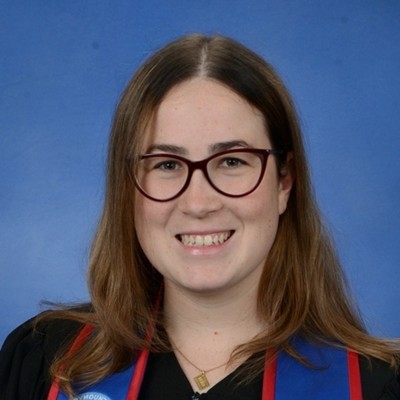
Laura Haushalter ‘26
Major: History and Environmental Studies
Next Step: Interfaith Pilgrimage with LMU’s Montserrat Pilgrimage program & Graduate School for Museum Studies
Q.) How did you end up choosing LMU?
A.) I chose LMU after a campus visit with former University Honors Program Director Dr. Trevor Zink. Dr. Zink invited me to campus to learn more about the Honors Program and LMU in general. He showed me around LMU and we had a great conversation about the type of faculty mentoring and research opportunities I would have. I visited on a gorgeous spring day in April, and fell in love with the bluff and the library. LMU is so beautiful, and I just sort of knew it was the place for me.
Q.) Why did you decide to double major in History and Environmental Studies?
A.) I entered LMU as an EVST major. I love running and spending time outdoors, and I knew I wanted to study the environment and anthropogenic climate change in college. I was drawn to the interdisciplinary nature of the EVST major and the freedom I would have to take EVST classes across disciplines.
I added a HIST major my sophomore year after taking the history courses ‘Museums and Society’ and ‘Modern Global Environmental History, ’ both with Dr. Amy Woodson-Boulton. The History Department was so welcoming and I realized I wanted to take more HIST classes. During my HIST studies, I learned about public history and fell in love with the unique challenges and opportunities public historians face. I added a history major because I believe that understanding past environmental challenges, and being able to clearly communicate environmental problems makes me a better environmentalist, and a more empathetic human. My history classes challenged me to think through complex past issues while also imagining a positive, more just, and environmentally friendly future. My majors complemented each other, and I am grateful for the experiences I have had in both the History and Environmental Studies Departments.
Q.) Do you have any minors? If so, how have they enhanced your academic experience?
A.) I don’t have any minors, but I have a History concentration in Environment, Science, and Technology, meaning I have taken a lot of environmental history classes!
Q.) How has your experience at LMU, and in BCLA, shaped you personally, academically, and professionally?
A.) At LMU, I have had opportunities to grow personally and spiritually. I went on several LMU Campus Ministry International trips, including to the Galapagos Islands, Northern Ireland, Spain, France, and Italy. These extracurricular trips gave me space to reflect on my own spirituality and values, while being in community with other LMU folks.
I have taken advantage of every opportunity to do research, which has helped me academically and professionally. I completed three large research projects while at LMU. The first was a cultural and environmental study of freeways as seen through postcards in the Werner Von Boltenstern Postcard Collection as part of a Honors Research Fellowship. I designed this research project, and spent a summer in the archive analyzing postcards as a historical object. My second large research project was a more than year-long group public history/digital humanities project on the history of Marymount College, the Loyola-Marymount merger, and Women Religious. I had the opportunity to collect oral histories, build a digital exhibition, and learn more about LMU. My third research project is my senior history thesis which explores the history of climate change exhibitions in American museums of natural history. I also worked as a Rains Research assistant for Dr. Amy Woodson-Boulton and participated in Dr. Married Sullivan’s digital humanities lab during the Summer Undergraduate Research Program (SURP).
LMU also supported my efforts to present my research. I presented my research at LMU and to a broader audience at the 2025 American Association for State and Local History annual conference, 2024 Phi Alpha Theta Culture and Conflict conference, and most recently the 2026 National Council on Undergraduate Research annual conference. My research paper, “Man-Dig those crazy Los Angeles Freeways: The changing image of Southern California Freeways in The Werner von Boltenstern Postcard Collection” was published in September of 2025 in the Undergraduate History Journal at Illinois. My research experiences taught me how to apply for research and conference grants, as well as get a taste of the publication process.
LMU also offered me opportunities to grow as a leader. I served as the upperclassman representative on the Student Honors Advisory Council and spent two years on Dean Fox’s Student Advisory Council. In these roles, I advocated for the importance of liberal arts and the student experience.
Q.) Do you have any important family influences or BCLA mentors, and how did they help guide you to this point?
A.) The entire History Department has been incredible and I am so grateful to Dr. Amy Woodson-Boulton for being my mentor and research advisor for the past three years. I admire Dr. Woodson-Boulton’s academic work in cultural history and her work as a climate activist. Additionally, Dr. Elizabeth Drummond, Dr. Nick Rosenthal, Dr. Carla Bittel, and Dr. Rebecca Wall have all been incredibly generous and have had such a positive impact on my time at LMU. They all encouraged me, supported my research, and taught classes that challenged me to think through complex issues. I appreciated that I could always go to any of their office hours and talk through class readings, receive feedback on writing, get advice or just learn about my professors’ own research.
Additionally, Cynthia Becket and the Department of Archives and Special Collections at the William H. Hannon Library was instrumental in my development as a researcher and I feel so lucky to have picked an undergraduate school with such an incredible library.
I am also grateful for the spiritual mentorship and guidance I received from campus minister Allie Holmquist.
Q.)What do you appreciate most about your liberal arts/Jesuit/Marymount education?
A.) I appreciate that LMU has both Jesuit and Marymount values, and my experience at LMU has been richer and better because of our shared Marymount and Ignatian History. LMU encouraged me to practice the Jesuit value of discernment and I know whenever I face a challenge I can use the skills of discernment to make a decision. My favorite part of the LMU mission statement is the pillar, “the encouragement of learning. ” BCLA professors, campus ministers, librarians, and my peers all encouraged me to learn through opportunities that challenged myself. Because of my time at LMU, I know to say yes to opportunities even if they scare me. I appreciate that my classes challenged me to think about my actions in the world and encouraged me to be a thoughtful citizen, which is one of the benefits of being at a liberal arts college.
Q.) What are your post-grad plans?
A.) Over the summer I am going on an Interfaith Pilgrimage with LMU’s Montserrat Pilgrimage program, part of LMU’s Campus Ministry. Then, I am moving to New York City to begin a Master of Arts in Museum Studies at New York University (NYU).
Q.) What are some of your future goals (professional or academic)?
A.) I want to work in GLAM (Galleries, Libraries, Archives, and Museums!). I want to combine my passion for the humanities and love of interacting with people. My dream is to work in natural history museums where I can do research and public engagement work with a focus on climate change.
Q.) Do you feel prepared for the future?
A.) Yes, I feel prepared for my graduate school studies and I am excited to build on the research and writing skills I have developed at LMU. My time at LMU was not perfect, and it taught me that even if things do not go quite to plan I can adapt, ask for help, and try new things. I think this lesson will be important for my future.
Q.) Do you have any parting advice for other students in BCLA?
A.) Yes, I have two pieces of advice. First, apply to Dean Fox’s Advisory board! I loved working alongside Dean Fox on BCLA issues I cared about. Dean Fox cares deeply about our college (e.g he has gone in a dunk tank twice for Dunk the Dean because the students asked him to), so if you want to be involved in making changes at LMU, the advisory board is a wonderful place to start. My other piece of advice is to try and watch the sunrise or sunset on the bluff as often as you can. Almost everyday, I would go outside and watch the sunset on the bluff and it was one of my favorite parts of my time at LMU.
Q.) Where are you originally from?
A.) I grew up in Southern California.