
Dr. Patricia Wright (Ph.D., CUNY), Herrnstein Chair Professor of Conservation Biology, Department of Anthropology, Stony Brook University, and Founder and Executive Director, Centre ValBio, Ranomafana, Madagascar.
When Dr. Wright traveled to Madagascar in 1986 she discovered the golden bamboo lemur, a species previously unknown to scientists. Her happiness was short-lived, however, when loggers flooded the area to cut the timber in the lemurs’ habitat. In order to save the rare lemur species, she spearheaded the Ranomafana National Park, inaugurated in May 1991. RNP was declared a UNESCO World Heritage Site in 2007.
After she and Stony Brook University turned the park over to the Madagascar National Parks Service, Dr. Wright organized a science-based integrated conservation and research organization, Centre ValBio, incorporating improvements in quality of life for both lemurs and humans, combining natural resource management with health, education and economic improvements for the region.
Dr. Wright has led over 60 field expeditions in Peru, Paraguay, Borneo, East Malaysia, Indonesia, the Philippines and Madagascar and has published five books and over 200 publications. Dr. Wright has supervised 34 doctoral students, earned three medals of honor from the Madagascar government, is a MacArthur Fellow (genius award), has been elected to the American Philosophical Society, is the first woman to win the Indianapolis Prize for Animal Conservation and is an elected member of AAAS.
Dr. Wright and her research team have come a long way since her discovery of the golden bamboo lemur. Over the past 20 years, as founder and international director of a state-of-the-art research station (CVB) overlooking the Madagascar rainforest, Dr. Wright has trained and guided both Malagasy and Stony Brook students and collaborated with a myriad of tropical biologists. CVB researchers have published more than 900 papers and produced more than 55 doctoral dissertations. Dr. Wright’s efforts to integrate environmental conservation with the well-being of local populations has been crucial for both lemurs and the Malagasy people and has set a world standard for conservation efforts.
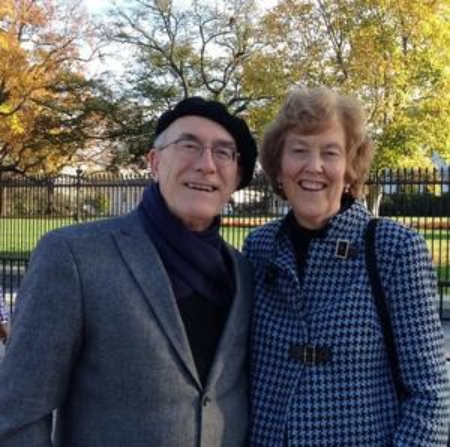
Mary Evelyn Tucker & John Grim, Co-Founders and Co-Directors of the Yale Forum on Religion and Ecology
Mary Evelyn's concern for the growing environmental crisis, especially in Asia, led her to organize with Grim a series of ten conferences on World Religions and Ecology at Harvard (1995-1998). They were series editors for the ten volumes from the conferences. She co-edited Buddhism and Ecology (Harvard, 1997), Confucianism and Ecology (Harvard, 1998), and Hinduism and Ecology (Harvard, 2000). After these conferences she and Grim founded the Forum on Religion and Ecology. They wrote Ecology and Religion (Island Press, 2014) and with Willis Jenkins they edited the Routledge Handbook on Religion and Ecology (2016). They also are series advisors for the Ecology and Justice Series at Orbis Books. They have created six online courses in “Religions and Ecology: Restoring the Earth Community.”
Tucker and Grim studied with Thomas Berry and worked closely with him for 30 years. Tucker edited Berry's books: The Great Work, Evening Thoughts, The Sacred Universe, and with Grim, The Christian Future and the Fate of Earth and Thomas Berry: Selected Writings on the Earth Community. Tucker and Grim also wrote Thomas Berry: A Biography with Andrew Angyal (Columbia 2019). To extend Berry’s work, Tucker created a multi-media project with Brian Thomas Swimme called Journey of the Universe, which includes an Emmy award winning film, a book from Yale (2011), Journey Conversations, and online classes.
John Grim teaches courses in Native American and Indigenous religions and world religions and ecology. He has undertaken field work with the Crow/Apsaalooke people of Montana and Salish people of Washington state. His published works include: The Shaman: Patterns of Religious Healing Among the Ojibway Indians (University of Oklahoma Press, 1983) and, with Mary Evelyn Tucker, a co-edited volume entitled Worldviews and Ecology (Orbis, 1994). He edited Indigenous Traditions and Ecology: The InterBeing of Cosmology and Community (Harvard, 2001) and co-edited the Daedalus volume titled Religion and Ecology: Can the Climate Change? (2001).