Theological Studies Graduate Programs
We are committed to the encouragement of learning, the education of the whole person, the service of faith, and the promotion of justice as rooted in educational tradition of Loyola Marymount University. We offer graduate programs in Theology and Pastoral Theology on a full or part-time basis.
M.A. in Theology

Loyola Marymount University's M.A. in Theology Program provides students with a firm foundation in the methods of biblical, historical, systematic, and moral theology, with special emphasis on the Roman Catholic tradition. The program engages students in a wide range of ethical and cross-cultural concerns, and in ecumenical and interreligious dialogue.
The goal of the program is to provide a general and integrated exploration of these areas for students seeking to teach on a secondary level, for students preparing for further graduate education, and for students with a strong interest in theology beyond the undergraduate level.
-
All students must complete 42 semester hours, maintaining a minimum grade point average of "B" (3.0). All courses are 3 semester hours.
Core Courses (21)
The following seven courses are required.
- THST 6010 Foundations of New Testament Theology or THST 6000 Foundations of Old Testament Theology
- THST 6020 Foundations of Historical Theology or any one course from 6020s
- THST 6030 Introduction to Systematic Theology
- THST 6060 Foundations of Theological Ethics
- THST 6090 Graduate Pro-Seminar (taken in the first semester)
- THST 6092 Comprehensive Exam Seminar (taken during final year in the Fall semester)
- THST 6093 Research and Writing Seminar (taken during final year in the Spring semester)
Elective Courses (21)
Theology Students are to complete an additional 21 semester hours for a total of 42 semester hours. Under special circumstances, students may take up to two courses (6 credit hours) outside the department.
Recent electives have covered topics in biblical studies, comparative theology, ecology, feminist and liberation theologies, and spirituality, among others.
M.A. in Pastoral Theology
The Master's in Pastoral Theology program engages the student in critical theological reflection on ministerial practice as preparation for active ministry in a pluralistic society. It provides theological foundations in pastoral theology, especially in the Roman Catholic tradition, and integrates the formation of persons preparing for pastoral ministry with their study of the Christian theological tradition (spirituality, liturgy, faith and culture, ethics, as well as biblical, historical, and systematic theology, and ecumenical and interreligious dialogue). The program stresses the holistic relationships between pastoral theology, faith seeking critical understanding, and faith that does justice.
-
All students must complete 42 semester hours, maintaining a minimum grade point average of "B" (3.0). All courses are 3 semester hours.
Core Courses (24)
The following eight courses are required:
- THST 6010 Foundations of New Testament Theology or THST 6000 Foundations of Old Testament Theology
- THST 6030 Introduction to Systematic Theology
- THST 6060 Foundations of Theological Ethics or One Course from the Historical Area (6020s)
- THST 6070 Foundations of Pastoral Theology
- THST 6074 Spiritual Formation for Pastoral Ministry
- THST 6078 Supervised Pastoral Field Education
- THST 6090 Graduate Pro-Seminar (taken in the first semester)
- THST 6091 Pastoral Synthesis Project (taken during final year)
Elective Courses (18)
Pastoral Theology students are required to take one course (3 semester hours) in Liturgy, Religious Education, or Spirituality and select other elective courses offered by the Department of Theological Studies after consultation with their advisor. Under special circumstances, students may take up to two courses (6 semester hours) outside the department.
Recent electives that have been popular with our Pastoral Theology students include topics in faith and culture, Ignatian spirituality, Latinx theology, and sacramental and liturgical theology.
About the Coursework
All coursework is normally taken as outlined in the university bulletin. Occasionally, course substitutions may be granted with the approval of the graduate director and Dean. For a look at recent offerings, view our current course descriptions and archive.
Transferring Courses
A maximum of six semester hours of graduate work completed in a non-degree status at Loyola Marymount University may be applied toward the graduate program. Similarly, a maximum of six semester hours of graduate-level work with a minimum grade of "B" (3.0) may be transferred from another accredited institution toward the graduate program.
Independent Studies Courses
A student who wishes to pursue an area of research which is not covered in any of the courses offered in the program can develop an independent studies course under the supervision of a full-time faculty member. No more than one independent studies course can be taken in any given semester, and no more than two can be counted towards the fulfillment of the course requirements for a degree. Students should speak with their advisor or faculty member if they would like to enroll in an independent study course.
Course Modalities
All courses meet once a week from either 4:30-7:00 pm or from 7:20-9:50 pm. Required courses are taught in a hybrid format, with students meeting together on campus for 3-8 times during the semester, and meeting on Zoom for the remaining class sessions. Elective courses may be offered in either a hybrid format or fully in person.
Learning Outcomes
Master's in Theology Learning Outcomes
Students will be able to:
- Perform biblical exegesis with attention to historical contexts, the history of interpretation, and contemporary theological developments;
- Engage in critical reflection on major theological themes, including the ability to articulate different perspectives and place them in dialogue, and the ability to engage such themes in real world contexts;
- Perform critical historical analysis, reading and interpreting primary sources of theology in their broader context;
- Situate contemporary theological developments in light of historical trajectories;
- Interpret the work of seminal thinkers in Christian ethics and analyze contemporary moral problems;
- Discern accurate and credible knowledge about diverse religious traditions and expressions;
- Engage the question of the theological significance of religious diversity;
- Articulate multiple methods in theological studies and apply them in appropriate scholarly ways and contexts;
- Engage critically with the Roman Catholic intellectual tradition, appreciating the internal diversity within Roman Catholic and wider Christian traditions, and articulating how an encounter with the Roman Catholic intellectual tradition enhances engagement with one’s own religious perspectives.
Master's in Pastoral Theology Learning Outcomes
Students will be able to:
- Assess pastoral situations from a critical stance;
- Reflect on ministerial practice in and perfect ministry skills for a culturally and religiously diverse society;
- Perform biblical exegesis with attention both to historical contexts and contemporary pastoral contexts
- Reflect critically on the praxis of faith and of justice within an ecumenically-minded Roman Catholic context
- Situate contemporary theological developments and pastoral practice in light of historical trajectories;
- Interpret the work of seminal thinkers in Christian ethics and analyze contemporary moral problems;
- Establish strategies and habits for the integration of one’s own faith, pastoral practice, and theological expertise.
Graduate Excursion Courses in Theology
Study Abroad Opportunities for Graduate Students
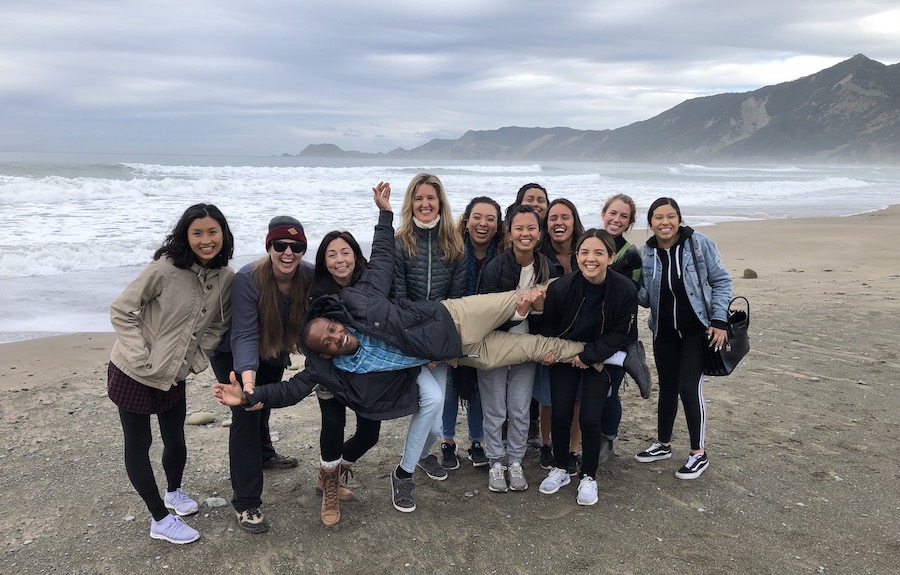
Excursions to other U.S. destinations and international study in theology can be a profound experience for graduate students. Each year, LMU's graduate theological studies programs offer optional one-two week excursion courses that give students a chance to apply theology to situations in the real world -- from New Mexico to New Zealand. Through travel and study, excursion courses invite us out of our comfort zones to experience Christian theology through other eyes and lives.
How to Apply
Before You Apply
In order for your application to be considered, you must have:
- A baccalaureate degree or equivalent from an accredited institution
- A minimum overall GPA of 3.0 for undergraduate coursework
- Applicants may submit scores from the GRE or Miller Analogies exams, but these are not required for admissions.
If you have questions, please contact:
Kayla Ray, Graduate Program Coordinator
Kayla.Ray@lmu.edu
University Hall 3754
(310) 338-1729
or
Layla Karst, Graduate Director and Associate Professor
Layla.Karst@lmu.edu
University Hall 3700
To attend an online Information Session, click here.
What To Submit
Applicants to the program must submit the following:
- An online application
- A $50.00 application fee (waived)
- Official Transcripts for all colleges/universities attended
- A Personal Statement describing your qualifications and motivations for graduate theological study - View Personal Statement Instructions
- Two Letters of Recommendation from persons who can speak to your capacity and preparation for the academic study of theology at the graduate level - View Guidelines for Recommenders
Students who have obtained their undergraduate degree outside the US must also submit:
- A course-by-course transcript evaluation by a US transcript evaluation service
- Test Scores from the Test of English as a Foreign Language (TOEFL) or the International English Language Testing System (IELTS) or the Duolingo English Test. Students who have received a high school diploma or a bachelor's degree from an institution whose primary language of instruction is English may request this requirement be waived.
Additional information for international applicants can be found here.
-
Accredited by the Commission on Accrediting of the Association of Theological Schools in the United States and Canada, the following degree programs are approved:
- M.A. in Pastoral Theology
- M.A. in Theology
The Commission contact information is:
The Commission on Accrediting of the Association of Theological Schools
in the United States and Canada
10 Summit Park Drive
Pittsburgh, PA 15275, USA
Telephone: 412-788-6505
Fax: 412-788-6510
Website: www.ats.edu -
There are many sources and types of assistance available to help finance your graduate education, including Departmental Scholarships and University Scholarships – both accessible through a single application process.
See here for more information and contact Program Coordinator Kayla Ray at Kayla.Ray@lmu.edu with any questions.
-
For both current and prospective students, this section provides you with additional information regarding Graduate-life resources available on our campus:
-
To listen, please click on the reflection below: